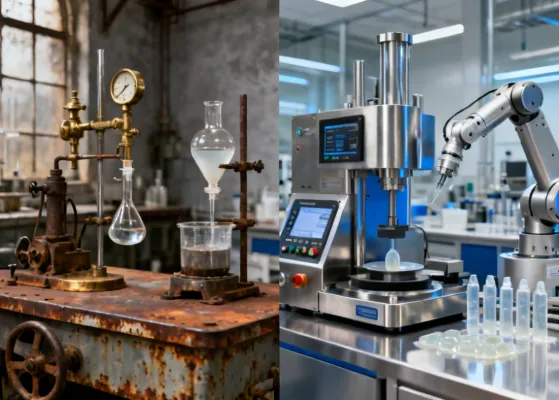
Founded in the early 1900s as a mining venture that pivoted to abrasives, 3M evolved into one of the world's largest adhesive and material science organizations. The adhesives division alone operates 51 distinct technology platforms, each mapping a different polymer chemistry to a class of bonding problems.
The company that would become 3M began mining corundum for sandpaper production in Two Harbors, Minnesota. When the mineral deposits proved unsuitable, the founders pivoted to manufacturing abrasive products — a decision that forced the company to develop adhesive coating technologies from scratch. That early constraint shaped a culture where solving a bonding problem matters more than selling a catalog item.
By the 1920s, 3M had introduced masking tape for the automotive paint industry. By the 1960s, the company held more adhesive patents than any other organization. Today, the adhesive technology portfolio spans pressure-sensitive adhesives, structural films, hot melts, reactive urethanes, and silicone systems — each refined through decades of empirical testing rather than theoretical modeling alone.
Richard Drew develops the first pressure-sensitive masking tape for two-tone automotive paint jobs, establishing 3M's adhesive tape business.
Drew extends the technology to cellulose film backing, creating Scotch transparent tape — the world's first clear adhesive tape.
Very High Bond acrylic foam tape enters commercial production, enabling structural bonding to replace rivets and welds in building and vehicle assemblies.
Adhesive production facilities expand to Europe, Asia, and Latin America, establishing regional supply chains with local technical support teams.
Published Environmental Product Declarations and ISO 14001 certification across all adhesive manufacturing facilities. Introduced low-VOC and bio-based adhesive platforms.
The adhesive division now operates 51 core technology platforms with over 100,000 patents globally, serving industries from aerospace to consumer electronics.
Our engineering process starts with your substrate pair and operating environment — not with a product catalog. This distinction matters because the right adhesive depends on the specific failure mode you need to prevent.
We characterize your substrates (surface energy, roughness, contamination), map the load profile (static shear, dynamic peel, cleavage), and define the environmental envelope (temperature, humidity, UV, chemical exposure).
We match your requirements against tested performance data — shear strength at temperature, peel adhesion curves, creep resistance under sustained load — rather than relying on generic product descriptions or marketing materials.
Before full-scale deployment, we provide sample kits and application protocols for on-site testing. Our technical team reviews your results and adjusts the specification if real-world conditions diverge from lab predictions.
Quality management across all adhesive production lines
Environmental management with published EPDs
Automotive quality standard for OEM supply
Product safety verification for electrical and fire-rated adhesives
Whether you are evaluating a new bonding method or troubleshooting an existing assembly, our adhesive engineers are available for technical consultations with no obligation.
Request a Consultation View Contact Details